
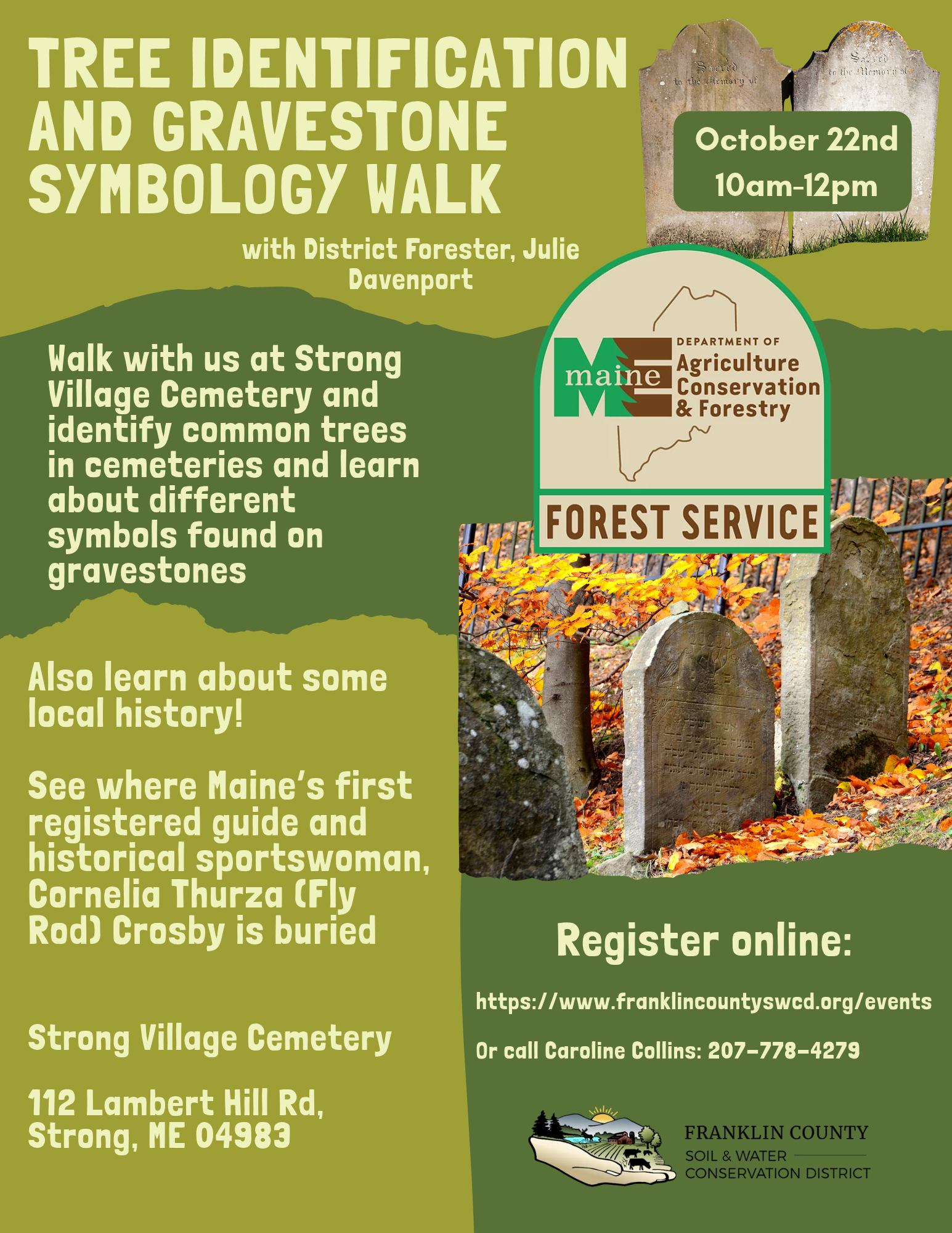
Tree ID and Gravestone Symbology Walk
Thursday, October 22nd 10am-12pm
Strong Village Cemetery
112 Lambert Hill Rd
Strong, Maine
DEP Basic and Advanced Erosion Control Practices
December 3rd, 2026
8:00am-4:00pm
Farmington Town Hall (downstairs room)
153 Farmington Falls Road
Farmington, ME 04938
$75 per person via cash/check or purchase for $81.88 online
Tickets available here:
This course is required to become Certified in Erosion and Sedimentation Control Practices by the Maine Department of Environmental Protection (DEP). In this eight (8)-hour course, participants learn why erosion control practices are important; be exposed to the principles of erosion and sedimentation; learn how to properly install and maintain Erosion & Sedimentation Control (ESC) Best Management Practices (BMPs); and become familiar with regulations requiring Erosion and Sediment BMPs. Participants are provided with information on the proper selection, installation, and maintenance of ESC practices in accordance with Maine DEP's Erosion and Sediment Control Practices Field Guide for Contractors.
The course is geared for, and of primary interest to contractors but could also be helpful to municipal code enforcement officers, consultants, engineers, and public works employees. Courses can be tailored to either an audience composed primarily of contractors or for inspectors and municipal officials.
This class qualifies for six (6) Continuing Education Hours (CEH) for individuals Certified in Erosion Control Practices by Maine DEP. Each CEH affords certified individuals one year of recertification. This class is approved for four (4) credits for Certified Tank Installers by the Board of Underground Storage Tank Installers, January 2023.
Past Events
Composting 101
Tuesday, September 29th at 5:30pm
UMaine Cooperative Extension Office
138 Pleasant Street, Suite #1
Farmington, Maine

Ag Day!
September 21st, 2026
Farmington Fair

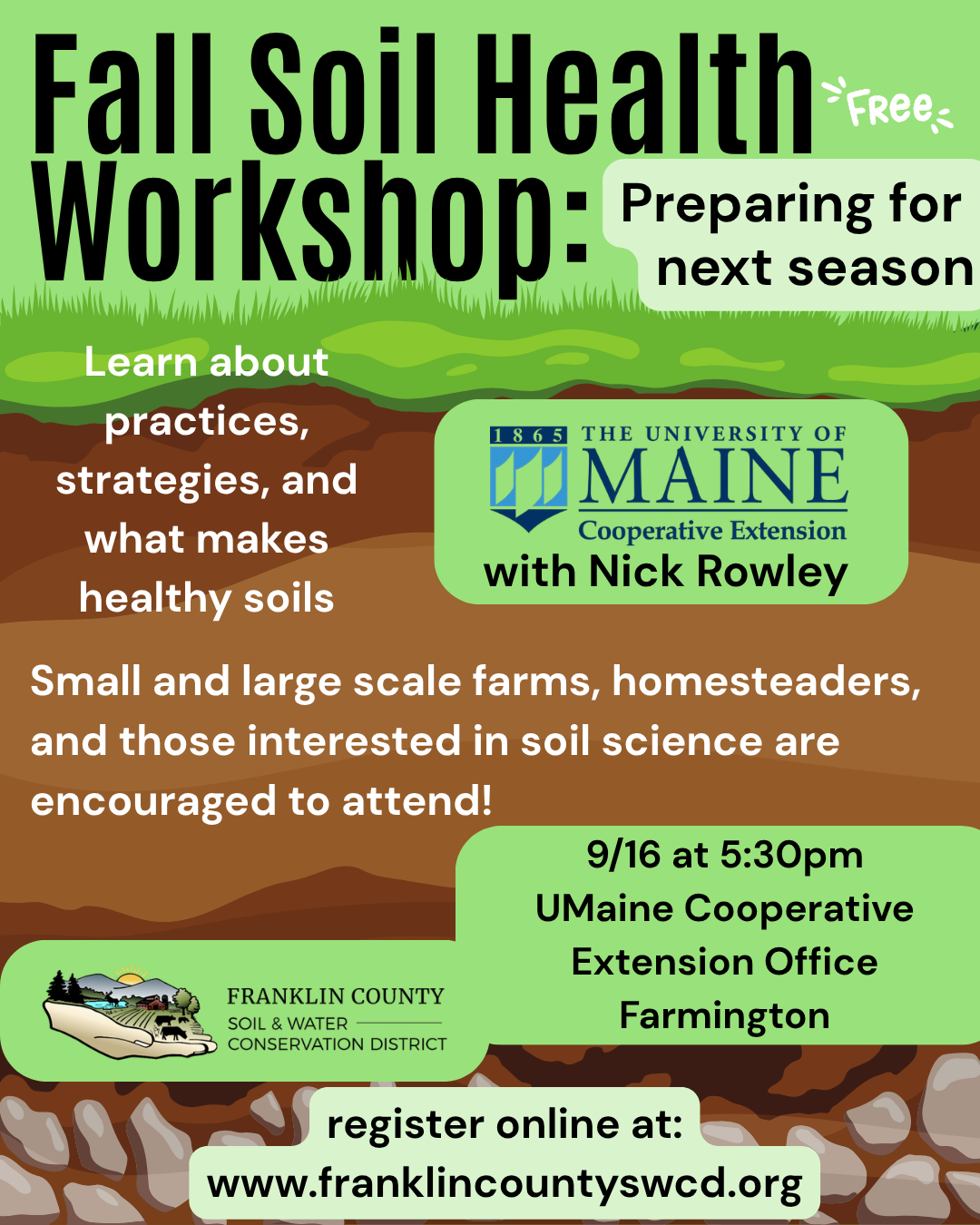
Fall Soil Health Workshop: Preparing For Next Season
Free!
September 16th, 2026 at 5:30pm
UMaine Cooperative Extension Office
138 Pleasant Street, Suite #1
Farmington, Maine
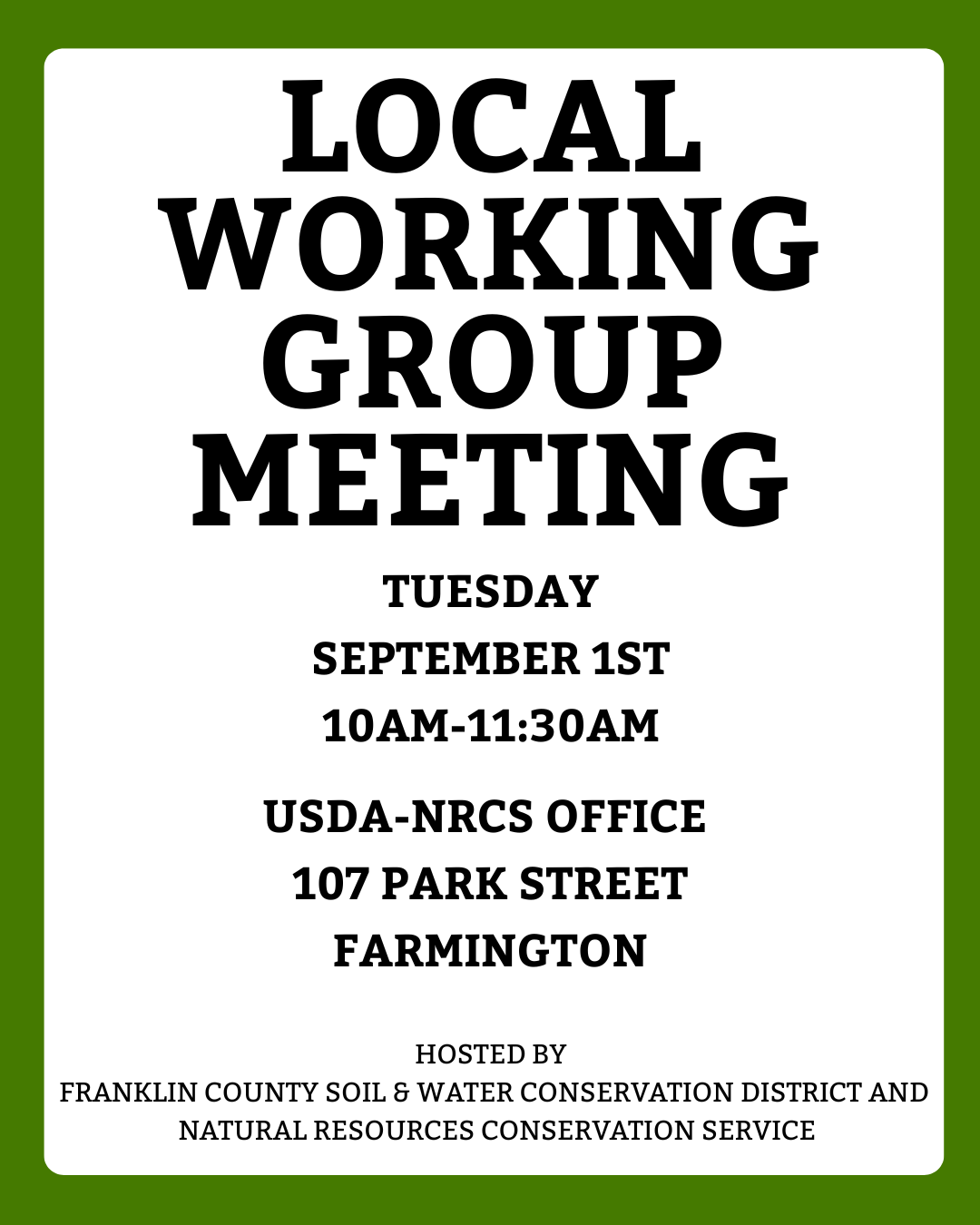
Local Working Group Meeting
Tuesday, September 1st
10:00 AM to 11:30AM
USDA-NRCS Office
107 Park Street, Farmington
The USDA Natural Resources Conservation Service (NRCS) and the Franklin County Soil and Water Conservation District invite all residents of Franklin County to attend and participate in a Local Working Group meeting.
The purpose of this meeting is to gather community input on natural resource concerns and make recommendations on conservation priorities, and the allocation of NRCS funds for programs in Franklin County. The agenda includes a discussion on EQIP programs, conservation priorities and practices, and local input.
Residents interested in natural resources, agricultural producers, woodlot owners, members of local environmental organizations, tribes, and professionals, are all welcomed and encouraged to attend.
The meeting is scheduled for Tuesday, September 1st from 10-11:30am at the USDA-NRCS office at 107 Park Street in Farmington.
For questions, please contact Caroline Collins at ccollins@franklincountyswcd.org
207-778-4279
Presentation on DEP’s Our SHORE Program
Thursday, August 13, 2026
9:00 AM to 10:00AM
Reunion Barn at Kineowatha Park
Wilton, Maine
Free!
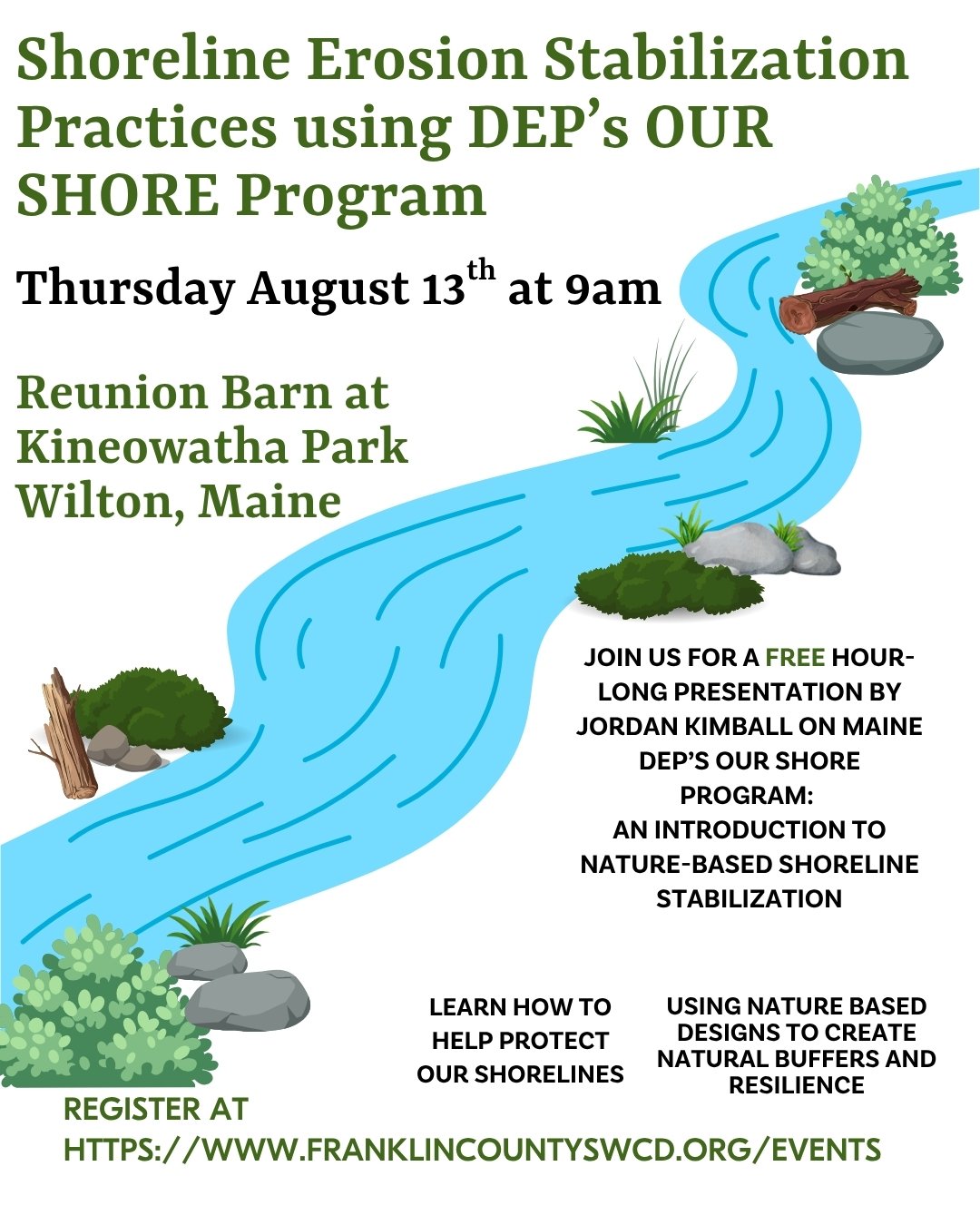
Join us for an hour-long presentation on DEP non-point source training center’s OUR SHORE program.
Soil erosion is not only a source of nonpoint source pollution, but it can also threaten structures and other development. Historically, there was a single approach to shoreline erosion: fill the shoreline with rock or riprap without regard to the ecological functions of the shoreline. While this approach has been successful in solving some erosion challenges when done correctly, it creates other problems for waterbodies and wildlife.
This talk introduces participants to resources and alternative approaches to protecting water quality and habitat to create resilient and stable shorelines. There are many common issues along shorelines that lead to erosion and instability. Sometimes, it takes several techniques to address the compounded problems resulting from poorly-sited development and land use. Criteria for choosing appropriate shoreland BMPs or bioengineering solutions include practices that cause minimal disturbance while providing maximum benefit. A combination of several techniques can often be used to ensure that the best practices chosen are suited to the specific site.